FlagshipSolo full-stack engineer
ScholarReach
Full-stack web app · For students applying abroad
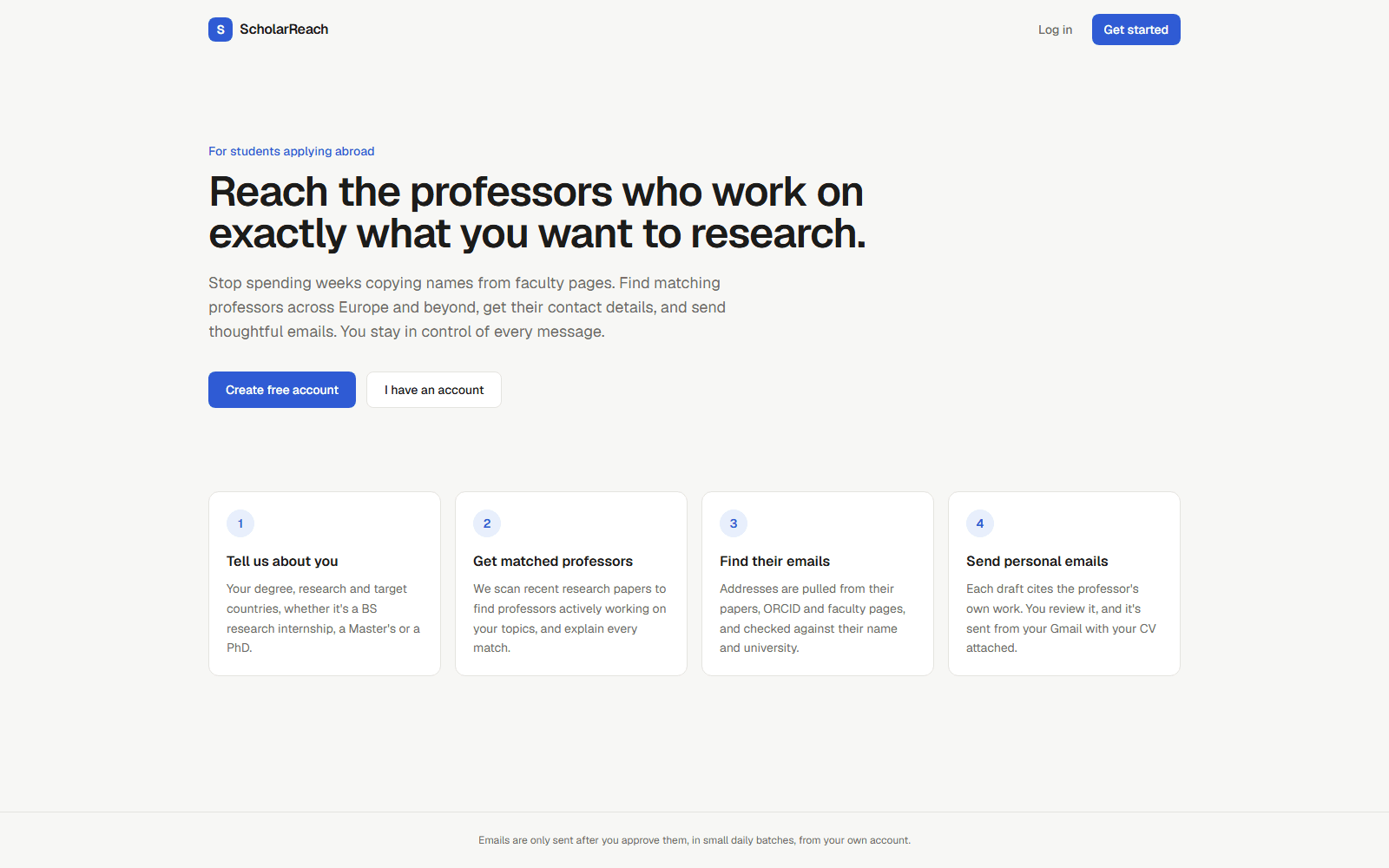
Finds professors who actually research your niche, gets their email addresses, and sends personal, reviewed outreach emails from your own Gmail.
Students applying for BS research, MS and PhD positions abroad were contacting professors at random — browsing university sites one by one, copying names into spreadsheets, guessing emails and sending generic messages to people who didn't work on their topic, so most got no reply. ScholarReach turns weeks of manual searching into minutes and keeps every email personal and approved by the student.
Demo available; private installs on request (VPS or own device).
Highlights
- Seven specialized agents run it end to end — profile, matching, email finding, department scouting, positions, writing and sending
- Matching Agent ranks professors from recent OpenAlex papers by topic match, lab leadership, funding and activity — every match shows its reasons
- Email Finder validates each address against the professor's name and university domain; likely-format guesses are clearly marked unverified
- Writer Agent drafts a personal email citing the professor's own paper; Sender Agent sends from the student's own Gmail (OAuth, send-only) only after approval
- Long scrapes split into ~20s resumable steps stored in the DB, so they survive serverless timeouts
- Responsible scraping: respects robots.txt, blocks requests to private addresses (SSRF), honors 429/503 Retry-After
- Security: bcrypt, JWT invalidated on password change, account lockout, single-use reset links, encrypted Gmail tokens
Stack
- Backend
- Python / FastAPI / SQLAlchemy (async) / PostgreSQL (Neon) / BeautifulSoup / httpx
- Frontend
- Next.js 16 / React 19 / TypeScript / Tailwind CSS 4
- Integrations
- Gmail API / OpenAlex / Europe PMC / ORCID / Google Gemini / Tavily / Serper
- Hosting & quality
- Vercel / Neon (Frankfurt) / Cloudflare DNS / 90 pytest tests
Office hours, by recipient
Each email goes out inside its recipient's office hours, not yours.
NewestSolo: product, backend, MCP integration, frontend and deployment
Mail Scheduler
AI agents · MCP · Automation · Full-stack · 2026
Client emails that arrive in their office hours, even with your laptop closed.
Freelancers and agencies emailing clients across time zones send at the wrong time: their working hours are the client's night. Gmail's Schedule send works one email at a time in your own time zone, and AI assistants' Gmail connectors can only send immediately, not later.
Mail Scheduler is an MCP-powered fix. Connect Gmail once and add a personal connector URL to Claude, ChatGPT, Cursor or any MCP client. Attach a client sheet in chat and describe the email; the assistant shows a dry-run preview of every rendered email with its send time in the client's local time, and schedules only after you confirm. A server queue then sends each one from your own Gmail inside the recipient's office hours, while your devices are off.
Built and shipped end to end in a few days, with Claude Code as pair programmer. Runs entirely on free tiers.
Highlights
- Per-recipient office hours: each client's IANA time zone, working hours and workdays, with weekends and late hours rolling to the next opening
- Works from any MCP client — Claude, ChatGPT (developer mode), Claude Code, Cursor — or from a web dashboard without AI
- Mail-merge personalisation from sheet columns ({first_name}, {company}…); a row is rejected if a placeholder is missing
- Engagement signals ranked by reliability — reply detection over IMAP (headers only), bounce detection, click and open tracking — with security-scanner and preview-bot hits filtered out, because a tracking pixel alone is unreliable under Apple Mail Privacy Protection and image blocking
- Multiple sending addresses per account and multi-user accounts; atomic claim-before-send so nothing goes out twice, retries with backoff, and safe handling of removed senders
- Remote MCP server on serverless: a stateless MCP app is built per request, with no long-lived session manager or startup events
- AI Gmail connectors send immediately and can't reach Gmail's scheduled send, so sending lives in a server-side queue, which is what makes it work on every AI platform. An hourly Claude cloud routine was the first prototype; cron-triggered SMTP replaced it for minute-level timing
Stack
- Backend
- Python / FastAPI / SQLAlchemy / PostgreSQL (Neon)
- AI integration
- Model Context Protocol / Python MCP SDK v2 / Streamable HTTP (stateless)
- Email
- SMTP / IMAP
- Dashboard & hosting
- Vanilla JS / Vercel (serverless) / cron-job.org / Cloudflare DNS
Caller
phone line
Vapi
speech in and out
Agents SDK
Gemini
FastAPI
validation
PostgreSQL
patient record
Voice AISole developer
Voice AI Patient Registration Agent
Voice AI agent · Patient intake · 2026
A phone agent that registers new patients through natural conversation, validates every detail, and saves the record to a database with a REST API and dashboard.
Callers dial a real U.S. phone number and talk to an AI intake coordinator. The agent collects name, date of birth, sex, phone, address and optional insurance and emergency-contact details, in whatever order the caller gives them. It re-asks for invalid values such as a future birth date or a six-digit phone number, accepts spelled-out corrections, reads everything back, and only saves after the caller confirms.
Behind it is a FastAPI service: Vapi handles the phone line and speech, the OpenAI Agents SDK runs the conversation on Gemini, and the agent's tools call the same validated service layer as a REST API. Records live in PostgreSQL and are visible on a dashboard alongside call transcripts and booked appointments.
Deployed on Railway during development; the hosted demo runs on trial credits and may be offline.
Highlights
- Real U.S. phone number answered by the agent — Vapi handles telephony, speech-to-text and text-to-speech
- Out-of-order conversation: callers can give several details at once, correct anything mid-call, or switch to Spanish
- Field-specific re-prompts for invalid data — future birth dates, wrong-length phone numbers, invalid states or ZIP codes
- Confirmation enforced in code, not the prompt: the save tool first returns needs_confirmation, so a read-back and caller reply are guaranteed before any write
- One validation layer shared by the agent's tools and the REST endpoints, with the key rules repeated as database CHECK constraints
- The LLM runs in the backend as an OpenAI-compatible custom-LLM endpoint, so prompt, tools and model choice stay version-controlled
- Model fallback when one is rate-limited, idempotent tool actions so a retried turn can't duplicate a patient, and a spoken apology if every model fails
- Returning-caller detection by phone number, appointment booking, stored transcripts, and 22 automated tests across the API, agent actions, LLM endpoint and call webhook
Stack
- Backend
- Python / FastAPI / SQLAlchemy / Pydantic
- Agent & voice
- OpenAI Agents SDK / Google Gemini / Vapi / Deepgram
- Data
- PostgreSQL / SQLite
- Dashboard & delivery
- HTML/JavaScript / Docker / Railway / 22 pytest tests
Dev toolSolo full-stack / AI engineer
VibeUI
Full-stack AI web app · Developer tool
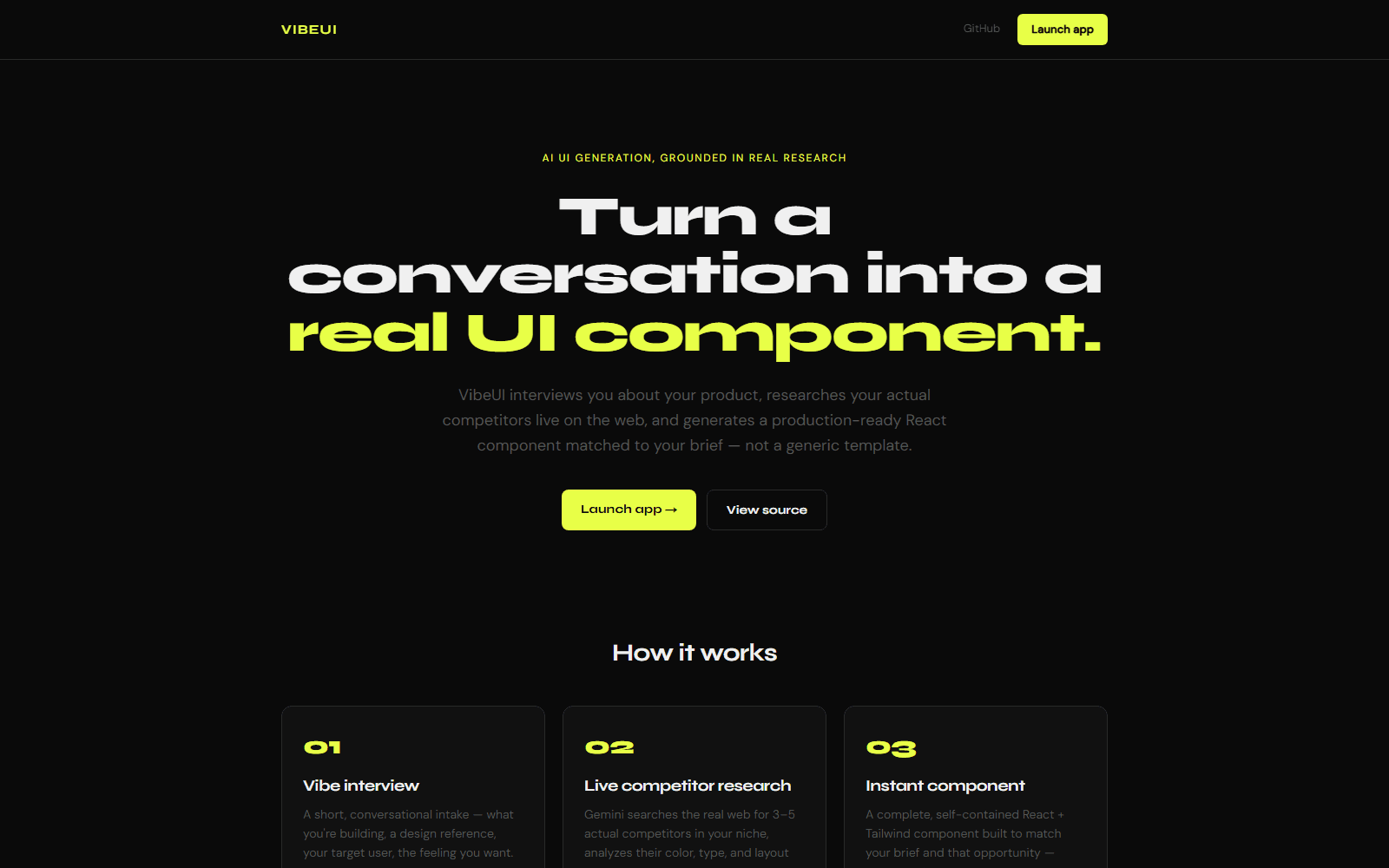
AI-powered UI generation from a conversation — describe your product, get a full set of production-ready React screens grounded in real competitor research.
VibeUI turns a short 4-question chat into a complete, multi-screen product UI. It interviews the user, researches their real competitors live on the web, and generates three production-ready React + Tailwind screens (e.g. landing + dashboard + settings) rendered in a live in-browser sandbox — built for people who can write the logic but freeze on frontend design decisions.
Highlights
- Conversational 4-question “vibe interview” that produces a structured design brief
- Live web-grounded competitor research (Google Search via Gemini) with a real-time activity log
- Multi-screen generation — 3 model-chosen screens per product, not a single component
- Live sandboxed preview (Sandpack) with code view and a screen switcher
- Multi-tenant auth with encrypted, per-user “bring your own key” API keys
- Per-account project history, plus a selectable generation model (Gemini 2.5 Flash / Pro)
Stack
- Frontend
- Next.js 16 / React 19 / TypeScript / Tailwind CSS v4 / Zustand / Framer Motion / Sandpack
- Backend
- FastAPI / Google Gemini 2.5 / Google Search Grounding / Fernet Encryption
- Data & Auth
- Supabase / PostgreSQL / Row-Level Security
- Deployment
- Vercel / Custom Domains